| Introduction
|
 Jig Dolls or Les Gigueux are old and established traditional wooden or
tin-plate 'toys' for adults and children alike. Jig Dolls or Les Gigueux are old and established traditional wooden or
tin-plate 'toys' for adults and children alike.
Basically they are dolls with loose limbs that step dance or 'jig' on
the end of a vibrating board or platform just like a real step or clog dancer.
Dancing dolls have always been
popular street entertainment for hundreds of years. In old 18'th and 19'th c.
London they were frequently seen operated by street entertainers or buskers. In the early
20'th c. old soldiers from the Great War sometimes busked with them to supplement their
meagre war pensions.
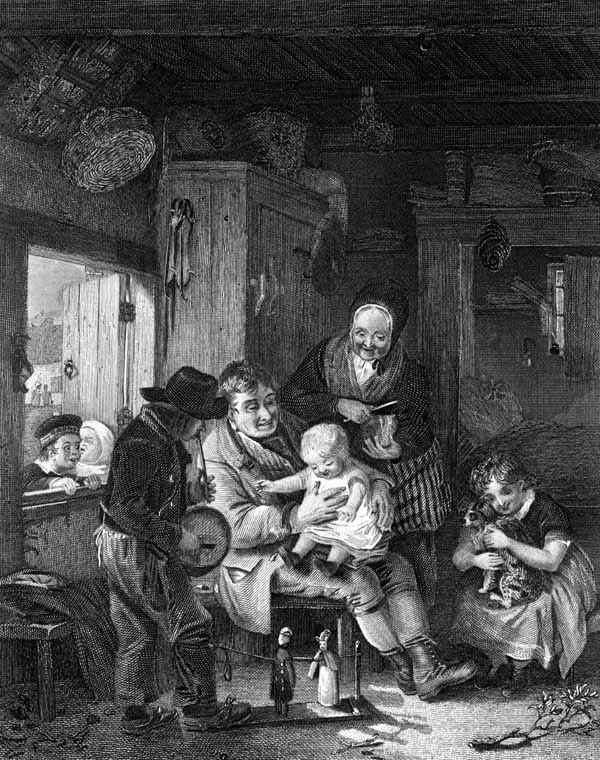 It has been recorded that dancing dolls
were first brought over to England from Italy by young itinerant musicians probably as
early as the 1500s. They were known as a 'Poupee a la
Planchette' or 'Marionettes a la
Planchette' or 'Les Petites Marionettes.' These were dancing
dolls or puppets operated by a horizontal string attached to the musician's leg, and which
'danced' somewhat randomly on a board or 'planchette' on the ground as the musician tapped
his foot as in the late 19th c. engraving on the left. It has been recorded that dancing dolls
were first brought over to England from Italy by young itinerant musicians probably as
early as the 1500s. They were known as a 'Poupee a la
Planchette' or 'Marionettes a la
Planchette' or 'Les Petites Marionettes.' These were dancing
dolls or puppets operated by a horizontal string attached to the musician's leg, and which
'danced' somewhat randomly on a board or 'planchette' on the ground as the musician tapped
his foot as in the late 19th c. engraving on the left.
Sometimes the dolls or puppets hanging from
the strings or rods would also be fitted to levers or wires as part of a framework of
musical instruments played as a 'one man band.' It is thought that the dancing dolls
operated by 'Seth Davy' were of this type.
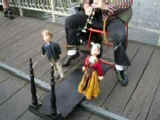 Marionettes a la planchette on the ground were,
and indeed still are, a popular street entertainment throughout Europe, e.g. in Ghent
(Belgium), in Cologne (Germany), and elsewhere. Marionettes a la planchette on the ground were,
and indeed still are, a popular street entertainment throughout Europe, e.g. in Ghent
(Belgium), in Cologne (Germany), and elsewhere.
There is an old U.S. patent from 1864 whereby
the doll hangs from an elastic thread round its neck which is then plucked to cause the
doll to dance; see: US Pat.
43759.
Many a doll from the mid-1800s right through
to the present time was supported by a  -shaped wire fastened to its back
or head, with the other end fixed to the static end of a springy board. The doll's feet
would just rest on the free end of the board, so that when the board vibrated the doll
danced. -shaped wire fastened to its back
or head, with the other end fixed to the static end of a springy board. The doll's feet
would just rest on the free end of the board, so that when the board vibrated the doll
danced.
It would not take too much imagination to
replace the supporting wire with a wooden dowel rod fixed into a hole in the back of the
doll's body. The doll would be held so that it's feet just rested on the free end of a
springy board, again dancing when the board vibrated. The oldest patent yet discovered
that describes what is today known as a jig doll dates from 1863; see US Pat. 40740. [Note that
this does not imply that jig dolls originated in the USA, it is just that the old
US patents that are online go back to the early 1800s, whereas the UK patents only go back
to the late 1800s.]
An old doll patented in December 1863 and
described as an American Painted
Wood Jigger Toy was sold recently by auction.
The East
Anglian Traditional Music Trust reports that the earliest English jig doll found to
date, a dancing one held with a stick in a hole in its back, is from the Victorian Great
Exhibition at the Crystal Palace dating from 1851. "It is a female figure
dressed in a skirt, petticoat, bodice and shawl, and is now in the Cliffe Castle Museum,
Keighley, Yorkshire." No photograph is available.
There are quite a few really old jig dolls either already sold in
auctions or currently listed in live auctions here: LiveAuctioneers - search for
"limberjacks" or "dancing doll" or "dancing toy" etc. - for
both 'Live' and 'Sold' listings. [Note that the use of the term 'limberjack' in these
auctions is purely generic and is not indicative of the use of that term in the 19'th /
early 20'th centuries; neither does it imply that a jointed doll offered for sale is loose
limbed and 'dances.']
Today home made and
commercial versions can be seen
and purchased in the UK, USA, Canada (esp. Quebec), some parts of Asia (Japan and Taiwan), Australia and New Zealand. But
surprisingly not in Ireland.

 I first came across jig dolls when I was at university in Loughborough
(1966-71), and when I was working for British Rail in Derby. At that time a folk duo Jacqui & Bridie were touring the Midlands.
They had with them some jig doll replicas given by Jean Ritchie from her
Appalachian family toys. I first came across jig dolls when I was at university in Loughborough
(1966-71), and when I was working for British Rail in Derby. At that time a folk duo Jacqui & Bridie were touring the Midlands.
They had with them some jig doll replicas given by Jean Ritchie from her
Appalachian family toys.
 Then in
the 1970s, when I was living in New Zealand, a visiting Canadian lady by the name of
Margot told me about those that she had seen in Canada and especially in Quebec. From then
on I determined to acquire one or two. In the
mid-1970s one of the first I purchased was unique as 'the man in the iron mask' from
Sydney Folk Festival in Australia. Then in the 1980-90s, as I travelled the
world as a member of BA staff, I built up quite a collection. Then in
the 1970s, when I was living in New Zealand, a visiting Canadian lady by the name of
Margot told me about those that she had seen in Canada and especially in Quebec. From then
on I determined to acquire one or two. In the
mid-1970s one of the first I purchased was unique as 'the man in the iron mask' from
Sydney Folk Festival in Australia. Then in the 1980-90s, as I travelled the
world as a member of BA staff, I built up quite a collection.
Now I have three Mr.
Jollyboy jig dolls from the early 1900s, and also many more modern jig dolls from all
over England, from the Appalachians (USA), from Quebec (Canada), and even from Sydney
(Australia). These are all used to entertain kids and adults at barn dances and festivals.
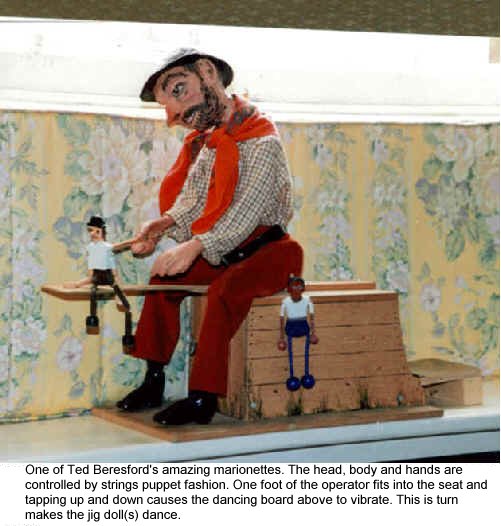
I also have an amazing marionette of myself in the costume of the Reading Cloggies that operates a jig doll that in turn also operates a jig
doll. This was made under commission from Ted & Kath
Beresford.
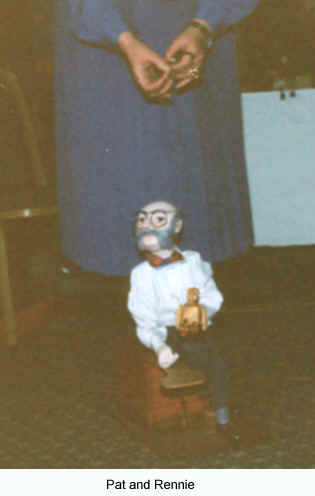
Then in the 1980/90s, when I was involved with the Reading Cloggies and
their annual Festival of Step and Clog Dance, I met the inimitable Pat and Rennie Pickles
who also had a large collection of jig dolls. For nearly every Festival Pat would drive
down from Yorkshire to set up an exhibition of these. After Rennie passed away Pat had a
marionette puppet made by Ted & Kath
Beresford that depicted Rennie operating a jig doll just as Rennie used to do. In the
video [*] of 'Pat Pickles' Jig Doll Party' Pat operates this to good effect. [*]
Email me for details - CJB.
 To
purchase your own jig doll(s) craft stalls at
Folk Festivals are the best places initially. At
these you can see the dolls and try them out. Craft Fairs may have them too - but you'll have to search every stall.
Some modern toy shops may sell them. Or better you can contact the makers listed below, expect to pay between £50 and £100
for a hand-carved and painted doll. To
purchase your own jig doll(s) craft stalls at
Folk Festivals are the best places initially. At
these you can see the dolls and try them out. Craft Fairs may have them too - but you'll have to search every stall.
Some modern toy shops may sell them. Or better you can contact the makers listed below, expect to pay between £50 and £100
for a hand-carved and painted doll.
There are some cheaper
factory made versions which lack any carving or decoration - they would
be good to start with - but usually they don't dance very well, but you could
personalise one by whittling some features onto it and then painting it. Here is an amazing painted version by one Bob Horner.
Sometimes an older doll can be
purchased from a specialist toy antique shop (at a price), but usually it is rare for a general antique shop to sell
them even if the owner knows what they are.
Or you could try eBay. But beware of purchasing from the USA - recently I was hit by one scam see: Jig Doll Wars on eBay. And whilst a doll may be cheap initially, charges by UK customs and the Royal
Mail / Parcel Force can be outrageously high, even for what can be deemed to be simply a
kid's toy.
Some antique clockwork tin-plate
jiggers can fetch many hundreds if not thousands of pounds (and dollars)!! Here's a link
to a great Jigging Sailor on
YouTube, priced on eBay at a 'buy now' price of £566 (=$950).
o United Kingdom
In the UK a Jig Doll usually goes by that name, or
maybe any of the following: Dancing Doll/Man - Clogging Man - Busker's Puppet - Clogger - Jigger
- etc.
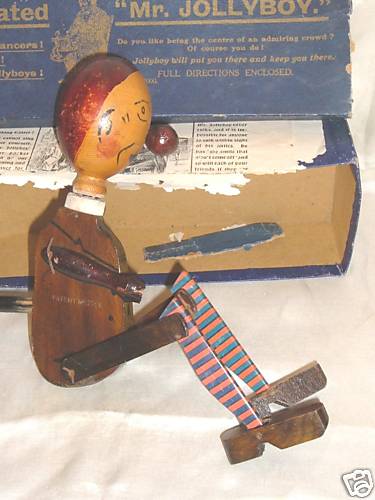 There was an early (but not the earliest) UK
patent no. 7725 describing a make of jig doll that was manufactured and sold as the
'celebrated' Mr. Jollyboy by the British company Dover Toys. This patent has been
renumbered as GB
190707725 A. There was an early (but not the earliest) UK
patent no. 7725 describing a make of jig doll that was manufactured and sold as the
'celebrated' Mr. Jollyboy by the British company Dover Toys. This patent has been
renumbered as GB
190707725 A.
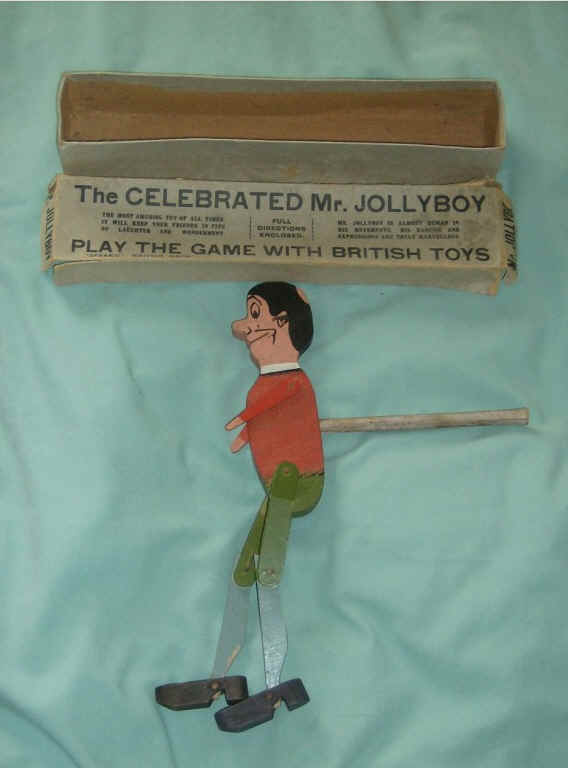
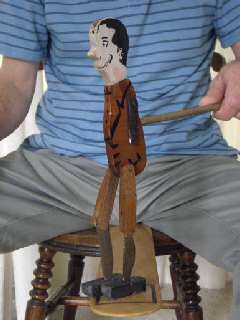 The standard version can be seen on the right (thanks to Chris Harvey for the photo). The standard version can be seen on the right (thanks to Chris Harvey for the photo).
One such 'standard' doll came up for auction recently
misnamed as: "Two dancing
limberjack toys" - of the two dolls depicted the one on the right has the typical
Mr. Jollyboy-type legs and feet; and it has been customised with a hat!
The 'de luxe' version of Mr. Jollyboy, based on the
same patent no. 7725, can be seen on the left. The oval head is mounted on a spring which
adds to the movement.
Just recently a different version of a 'celebrated'
Mr. Jollyboy came up for auction on eBay. It was made by the British toy company 'Speako.'
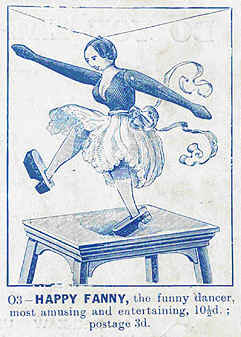
Mr. Jollyboys were sold by mail-order by Copland & Lye's,
who also sold a dancing toy called Happy
Fanny - a cross between a jig doll and a marionette a la planchette.
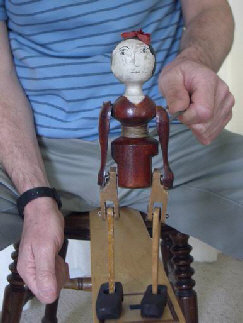  A Mrs.
Jollygirl has been recently discovered, however it is now
thought that this was a home-made 'one-of' version (thanks to Chris Harvey for the photo). A Mrs.
Jollygirl has been recently discovered, however it is now
thought that this was a home-made 'one-of' version (thanks to Chris Harvey for the photo).
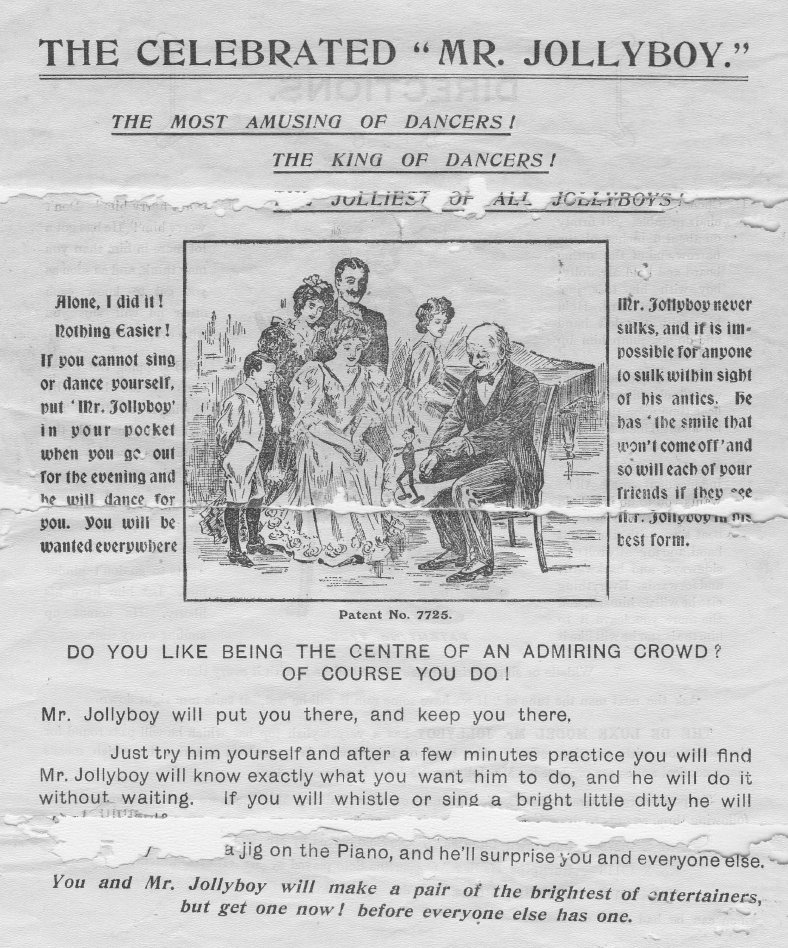
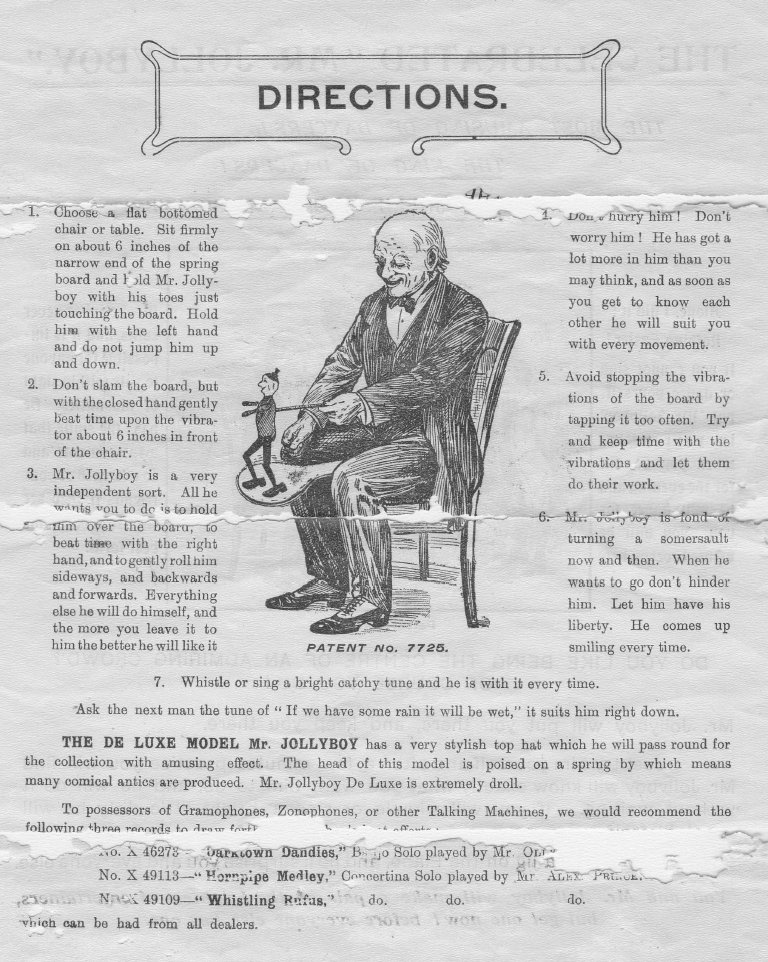
An instruction sheet was always included in the Mr.
Jollyboy box, such as this one - page 1
/ page 2.
The sheets also recommended various 78rpm records that
could be used as music for Mr. Jollyboy to dance to. One example lists: Darktown
Dandies - banjo solo by Olly Oakley # Hornpipe Medley - concertina solo by Alexander
Prince # Whistling Rufus - concertina solo by Alexander Prince. Another instruction sheet
lists: Lumbrin Luke - banjo solo by Olly Oakley (MP3 at Archive.org / YouTube) # Toronto Jig - banjo solo
by Olly Oakley (MP3 at Archive.org)
# Fidgety Phil - ?
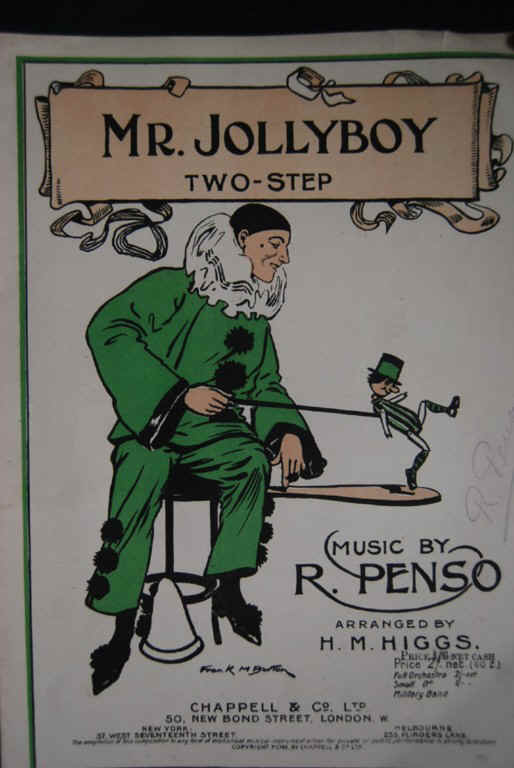
In the early 1900s, there were also a number of music
sheets issued with song(s) and tune(s) entitled "Mr. Jollyboy." (See: Mr. Jollyboy Two-Step below). Copies of these have been located in
the British Library and the National Library of Australia.
Olly Oakley also recorded one banjo tune called Mr.Jollyboy (YouTube) and Whistling Rufus (YouTube). There is
only one recording of Fidgety Phil on the web at Ragtime
Soundfiles.
Further info. about Olly Oakley can be found at Homage To Oakley - Part 2; and
here about Alexander
Prince.
o USA (incl. Appalachia)
In the USA, a Jig Doll would be called
a: Dancing Doll/Man - Paddle Puppet - Stick Puppet
- Limberjack or Limberjim or Limberjill or Limbertoy - etc.
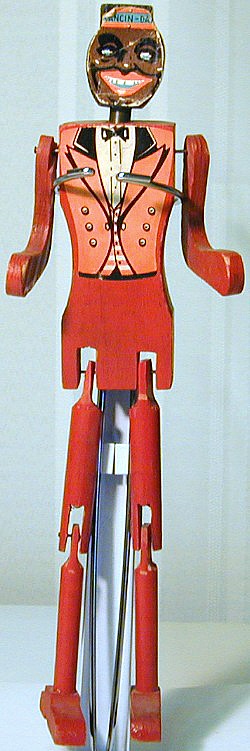 A commercial version
from the 1930s was called: Dancin'
Dan and Dancin' Dina 'one of the famous family of wonder wooden tap dancers'
copyrighted by the Associated Syndicate company of Des Moines, Iowa (see right). Usually
its head was on a spring, and in some examples its waist was also jointed with a spring. A commercial version
from the 1930s was called: Dancin'
Dan and Dancin' Dina 'one of the famous family of wonder wooden tap dancers'
copyrighted by the Associated Syndicate company of Des Moines, Iowa (see right). Usually
its head was on a spring, and in some examples its waist was also jointed with a spring.
Then there was Steppin' Sam made by the Steppin'
Sam Co., 4458 Griscom St., Philadelphia, PA. On the board there is an imprint which states
a copyright of 1938.
Yet another commerical version was a Mr. Bojangles (Bill Robinson) made
by the Clown Toy Manufacturing Co., Brooklyn, New York.
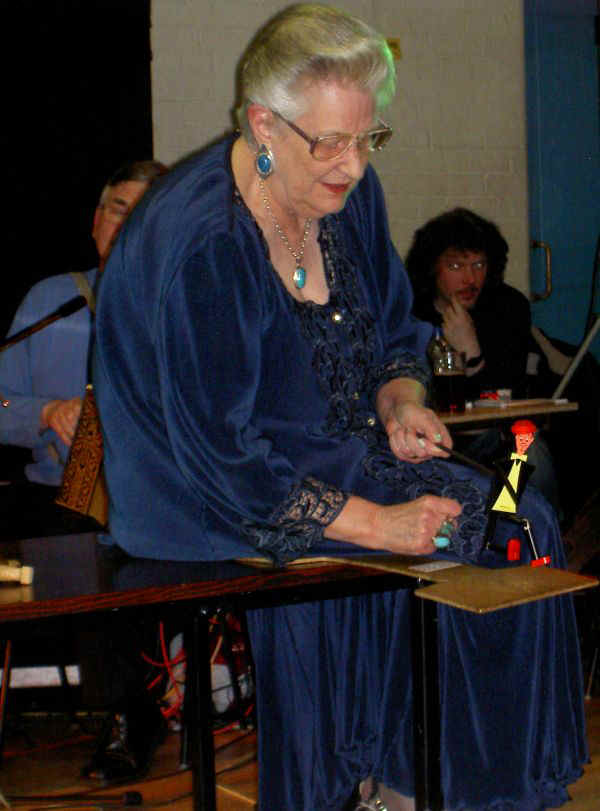 Mr.Tap'n'Go was
another commercial version from the late 1960s made by the Triple R Machine Co. in
Burbank, CA. On the left is Pat Pickles dancing a Mr. Tap'N'Go at the 50th anniversary
party at Cecil Sharp House for the English/Irish folk dance band 'The Rakes.' Mr.Tap'n'Go was
another commercial version from the late 1960s made by the Triple R Machine Co. in
Burbank, CA. On the left is Pat Pickles dancing a Mr. Tap'N'Go at the 50th anniversary
party at Cecil Sharp House for the English/Irish folk dance band 'The Rakes.'
Yet another version was Dapper Dan or see Dapper Dan.
And another was "JIGGING SAM, the Tap Dancing WONDER. AMERICA'S Most Popular
"ENTERTAINER."
Tapping Tim
was a home-made electrical version described in Popular Mechanics.
Other versions were called: Jazbo Jim - Dancin' Jo - Dancin' Minstrel - etc.
Note that in the Appalachians the general term
amongst the old-timers was 'dancing man,' however the term 'limberjack' may been
introduced in the late 1800s when such home made toys started to became commercially
produced. The term may have come from its loose 'limber' method of dancing; and 'Jack' was
the generic name for any boy (ref. the tradition of Jack tales). Some of the
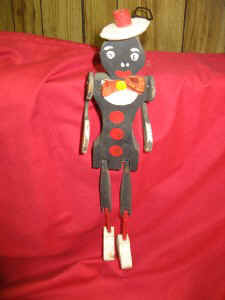
dolls from Appalachia are beautifully hand carved (whittled) and
painted such as this Black Americana Whittled
Limberjack from Berea Christmas Country Dance School in 2002. No patents use the term
'limberjack.'
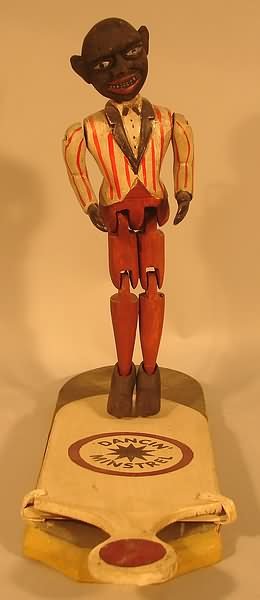 Somewhat politically incorrect, but part of what is now termed
collectable 'Black Americana,' are wooden, whittled, and painted step or tap dancing toys
such as the 'Dancin'
Ballerina' that is seen regularly on various auction sites and on eBay (see right).
Earlier versions can date right back to the mid-1800s and may be earlier. Somewhat politically incorrect, but part of what is now termed
collectable 'Black Americana,' are wooden, whittled, and painted step or tap dancing toys
such as the 'Dancin'
Ballerina' that is seen regularly on various auction sites and on eBay (see right).
Earlier versions can date right back to the mid-1800s and may be earlier.
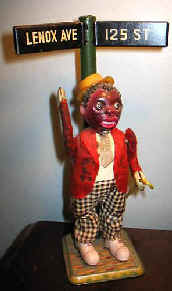 In the early 1950s the civil rights organisation,
the radical NAACP (National Association for the Advancement of Colored People), forced the
removal of all such dolls from toy shop shelves certainly in New York; ref: The Case for the
South - Page 57 - by William Douglas Workman - 1960. "In August of 1950, a
dancing Negro doll, made in Japan and depicting a Negro figure standing beneath a Lenox
Avenue-125 Street sign (see left), was withdrawn from the New York toy market. The
Associated Press reported that the jig-dancing doll was removed from store shelves when
the NAACP complained that it 'served to perpetuate an old stereotyped conception of
negroes which recent developments in race relations have all but banished.'" These
were 'Made in Occupied Japan' with US patent numbers. Street sign marks Lenox Ave and
125th St, which marks a Subway entrance. These two streets today are also known as Dr.
Martin Luther King Jr. Blvd. and Malcom X Blvd. In the early 1950s the civil rights organisation,
the radical NAACP (National Association for the Advancement of Colored People), forced the
removal of all such dolls from toy shop shelves certainly in New York; ref: The Case for the
South - Page 57 - by William Douglas Workman - 1960. "In August of 1950, a
dancing Negro doll, made in Japan and depicting a Negro figure standing beneath a Lenox
Avenue-125 Street sign (see left), was withdrawn from the New York toy market. The
Associated Press reported that the jig-dancing doll was removed from store shelves when
the NAACP complained that it 'served to perpetuate an old stereotyped conception of
negroes which recent developments in race relations have all but banished.'" These
were 'Made in Occupied Japan' with US patent numbers. Street sign marks Lenox Ave and
125th St, which marks a Subway entrance. These two streets today are also known as Dr.
Martin Luther King Jr. Blvd. and Malcom X Blvd.
It may have been at about this time that the term 'limberjack' was
introduced as a more acceptable term for the black jigging toys / dolls.
o Canada (incl. Quebec)
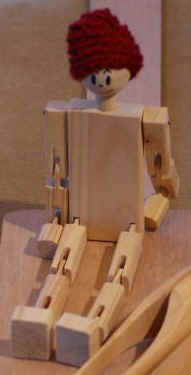 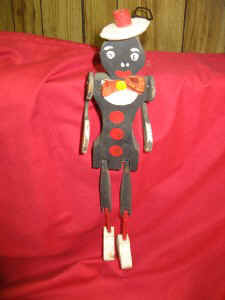 In
Quebec, Canada, the French-Canadians refer to these as: Les Gigueux - Bonhomme Gigueur or
Gigueux - Bon Hommes - Gigueux de Bois - Step Dancing Doll - 'Marionnette et instrument de
percussion' - etc. (see left). In
Quebec, Canada, the French-Canadians refer to these as: Les Gigueux - Bonhomme Gigueur or
Gigueux - Bon Hommes - Gigueux de Bois - Step Dancing Doll - 'Marionnette et instrument de
percussion' - etc. (see left).
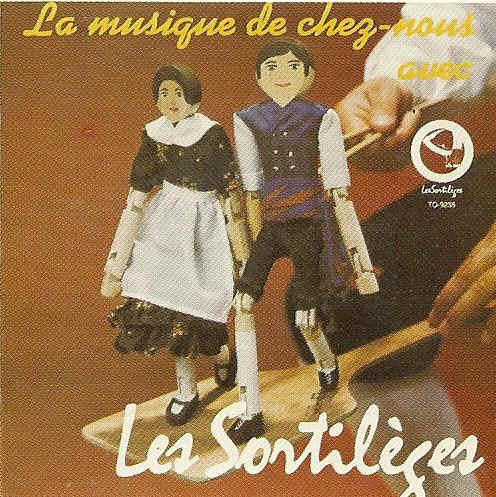
Some many even have traditional costume including the traditional woolen
woven waist band - ceinture_fléchée
- worn by folk and step dancers (see Les Sortilèges - top right).
Sometimes one (or more) gigueur can feature as a percussion instrument
for a folk dance band, even to the extent of the plank on which a doll 'dances' being
fitted with a small mic. connected to the p.a.
Recently an example from London, Toronto was featured on eBay
manufactured by Hobby Nobby, Maitland St., London, Ontario (see right).
o Europe (ex-UK)
In France the term Jack Agile is used.
And in Ireland? Well curiously there are no
references to jig dolls in Ireland, despite the strong tradition(s) of step dancing in
that country.
o Far East
According to sales of jig dolls on
eBay (under various guises and names) commercial versions have recently been produced in
Taiwan and Japan (and most likely China) as representative of American folk-culture
usually to commemorate various sporting or cultural event.
o Searches
The above wording can all be search
terms on Google, Yahoo,
YouTube, eBay, and
on various auction sites such as LiveAuctioneers,
etc.
Also try searches on eBay such as
"dancing+doll" -
this will also pick up mechanical dancing toys some of which could be automated dancing
dolls.
Searches can also be made on Google Books using something like "dancing+toy".
Try searching Yahoo - Images for:
"limberjack"
/ "limberjacks"
/ "jig+doll"
/ "jig+dolls"
/ "dancing+doll"
/ "dancing+dolls"
/ "tap+dancing+toy" / "bojangles" / "dancing+minstrel" etc.
o Varieties of Dolls
 But jig dolls are essentially homemade, and now-a-days you
can see versions like costumed sailors, costumed folk-dancers (like those in the picture
from Les Sortilèges - a folk dance performing group from Quebec),
African-Americans, Native
Americans, morris dancers (Cotswold
/ Costwold
and NW Clog), English clog dancers (clogs = wooden-soled shoes), Punch & Judy, clowns,
Uncle Sam, Cowboy, Confederate Soldier, Charlie Chaplin,
"Tommy Atkins" (a British WW1 soldier), Adolf Hitler (on YouTube), a
Scotsman in a kilt, Lady
Godiva, Santa,
Henry the Dog, other animals such as horse / horse / horse / horse, pigs, bulls , chickens
/ chickens, dogs / dogs / dogs, frogs / frogs, bears, dinosaurs, a skeleton But jig dolls are essentially homemade, and now-a-days you
can see versions like costumed sailors, costumed folk-dancers (like those in the picture
from Les Sortilèges - a folk dance performing group from Quebec),
African-Americans, Native
Americans, morris dancers (Cotswold
/ Costwold
and NW Clog), English clog dancers (clogs = wooden-soled shoes), Punch & Judy, clowns,
Uncle Sam, Cowboy, Confederate Soldier, Charlie Chaplin,
"Tommy Atkins" (a British WW1 soldier), Adolf Hitler (on YouTube), a
Scotsman in a kilt, Lady
Godiva, Santa,
Henry the Dog, other animals such as horse / horse / horse / horse, pigs, bulls , chickens
/ chickens, dogs / dogs / dogs, frogs / frogs, bears, dinosaurs, a skeleton  , a mule,
and even a Spudhead,
etc. , a mule,
and even a Spudhead,
etc.
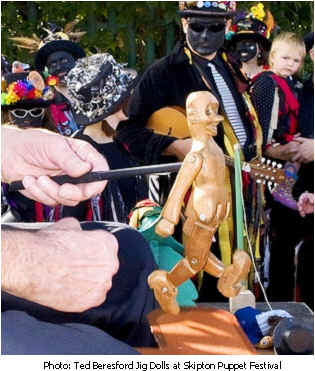
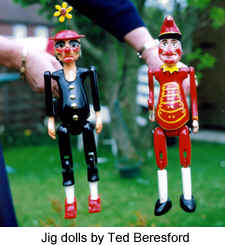
Professional puppeteer Ted Beresford
makes wonderful gaily painted jig dolls and incredible marionettes that also operate jig
dolls.
 Some Punch
and Judy Professors also have jig dolls to attract an audience. One has a jig doll of
Charlie Chaplin which may sometimes be seen at the annual Covent Garden Punch & Judy
Festival in London. Some Punch
and Judy Professors also have jig dolls to attract an audience. One has a jig doll of
Charlie Chaplin which may sometimes be seen at the annual Covent Garden Punch & Judy
Festival in London.
In the UK many folk dance bands have
a jig doll that may come out to entertain the audience in the interval of a barn dance.
This is always a popular 'act' for any kids (and adults) present.
At other times you might see someone
busking in the street with a jig doll. See 'Seth
Davy' below.
If there is a live music session in
a pub in England then a jig doll might make an appearance to step dance for the crowd.
Equally likely in the past a regular feature of such a pub session would be step dancing by members of the
audience. Now with the latest draconian and expensive licencing regulations in England,
playing live music and step dancing
is largely illegal and therefore banned. So in effect even 'playing' jig dolls in pubs or
in public has been out-lawed by the English Government!
| How Are Jigs Dolls Made?
|
Some instructions can be found here: Dolls in Canada -
Instructions p.112
/ 113 / 114 / 115 [pages may
not always show].
An excellent index of magazine
articles can be found at NLEINDEX.
To obtain a copy of any magazine article contact your local public library
or the publisher.
The basic versions of jig dolls are
the homemade varieties with joints at the arms, elbows and sometimes the hands; or
additionally with joints at the hips, knees and sometimes the ankles. The
best dancing dolls have ankle joints with the toes slightly hanging below the heels.
Of course the nicest jig dolls are the homemade variety, sometimes
whittled with a simple pocket knife.
Jig doll are still made in the UK. Their charm, and what makes them
collectable, is that being mainly homemade nearly every single one is different.
Beechen Cliff
is one enterprising school that includes woodworking lessons on making jig dolls in the
curriculum.
In the Appalachian Mountains of the USA such toys were made locally in
the mid-1800s right through to the present time. In olden times children's toys were
essentially home made, and such a dancing doll might be a child's treasured possession for
many years. This still living tradition is illustrated in this remarkable set of slides: Dancin' Dolls and Walkin' Mules.
One mistake some folks make is to glue the stick into the back of the
doll. This is not a good idea and it makes packing up &/or posting difficult!!
| Varieties
When searching for different
versions there are many varieties of jig doll, with:
|
o Support
o a wooden stick/dowel in a hole in the back
o a wire
in a hole in the back perhaps with a screw thread
o a stick with a hook at one end linking to screw eye on top of the head
o strings from a cross-frame held above like a conventional puppet
o a string through the body one end of which is fastened to say a chair leg
whilst the other end is tied to a musician's leg (e.g. a marrionette a la planchette)
o a marionette-type puppet which operates a smaller jig doll via conventional
puppet strings
o Decoration
o a doll of bare wood (maybe varnished)
o a fully painted doll
o a fully clothed doll
o Joints
o a doll jointed at the shoulders, hips and knees
o a doll also jointed at the elbows, wrists and ankles
o Board / Planchette /
Paddle
o a plane rectangular board
o a specially shaped board perhaps for two dolls at once
o a board for sitting on sideways
o a board for sitting on which comes out forwards between the legs
o a stationary or vibrating platform, i.e. automated somehow
o Vibrations
o the board vibrated by the free hand/fist just forward of where the board is
sat upon
o the board flicked with the fingers where the doll dances
o some kind of machanical linkage to a mechanism, or maybe even sound waves, to
cause the board or platform to vibrate
o the board or dancing platform remains still and the body of the doll is
vibrated by an oscillating rod passing vertically through its body
o Energy
o 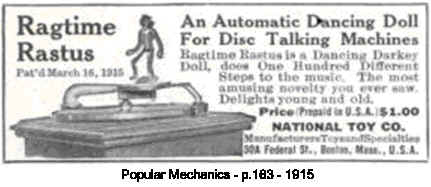 the energy to vibrate the board, platform or doll can be a
human beating his/her fist or fingers in time to the music the energy to vibrate the board, platform or doll can be a
human beating his/her fist or fingers in time to the music
o a simple clockwork or an electric motor to vibrate the platform or the doll
itself
o dry falling sand driving a paddle wheel linked to a vibrating mechanism, i.e.
a dry sand engine
o a microphone that picks up sound waves and converts them into the vibrations
of a platform or loud speaker
o Unusual Versions
o
as in a whirligig / whirligig / whirligig: i.e. the wind blows a
windmill, which turns a shaft, which causes a loose limbed doll to jig on a board
o as produced by the Edison
Gramophone Company and the National Toy Co.
for attaching to a 78 rpm phonograph or gramophone - price about $1! This was apparently
patented on March 16, 1915: US
Pat. 1131895. Another patent was dated June 17, 1920: GB
144475 A
o Etc., etc.
| Early Patents
All of the above varieties can be
found in the various UK and USA Patent applications.
|
o Patents
It is apparent that jig dolls firmly
come from the various step dance and
clog dance traditions of the British Isles. It has been opined that in the British Isles
in the 1800s step dancing and clog dancing was the most popular form of self-produced
entertainment. This was emulated in the USA where African-Americans became especially
adept at this dance form.
And so the appearance of step
dancing dolls for entertainment is no surprise, especially since 'marionettes a la
planchette' were (and still are) popular for many centuries throughout Europe. Dancing
dolls were produced in wood or tinplate, they were hand operated or mechanised, the
simpler ones were easy to make at home, and they were all immensely popular - so much so
that it seems that every 'improvement' warranted a patent!!
All patents are now online, the US
patents dating back to the early 1800s, the European patents dating back to the late
1800s. However this doesn't imply that the US first invented jig dolls.
The earliest patents for jig dolls
date from about the mid-1800s. As already mentioned the oldest patent yet discovered dates from 1863; US Pat. 40740. An old doll
patented in December 1863 and described as an American Painted Wood Jigger Toy
was sold by auction recently. From various auctions, some old dancing dolls may date from
the early 1800s.
It could be that these dancing dolls
were created by sailors on the old windjammers, who when becalmed whittled (carved) these
step dancing figures for their kids back home. The reasoning for this is that it was an
English Master Mariner, one Harold Percy Rugg (of 127 Station Street,
Burton-on-Trent in England) who on 14-Mar-1904 filed
the first known English patent for a dancing doll. The actual patent document with
diagrams is here: GB
190406198 A.
A few years later an American
electrician, one Harry William Thornton, Electrician (of Winona, County of
Winona, State of Minnesota, United States of America) filed a similar patent on
06-August-1906 in the USA. The actual patent document with diagrams is here: US Pat. 845985.
Then on 02-Mar-1907 he also took out a similar patent in the UK. The
actual patent document with diagrams is here: GB
190707725 A. It appears that this was eventually turned into a commercial version
called Mr.Jollyboy by Dover Toys, of which examples can often be seen for sale on eBay.
o Other Patents
All varieties of these dancing toys
can be seen in the various patents for improvements of same. Usually these involve some
kind of 'improvement' to the mechanical automation of vibrating the plank or plate upon
which the doll dances; or maybe 'improved' mechanisms to rapidly vibrate the doll itself
up and down with the feet just touching a static plate.
Over 450 possible patents can be
found in the USA: US Patents. Note that no patents use the term 'limberjack.'
Similar interesting patents can be
found in the UK: UK Patents.
It appears that these 'improvements'
continued to be made from the late 1800s and indeed still continue right through to the
present day. This is a particularly interesting one from 10-April-1975: US Pat. 3990178
| How Do Jigs Dolls Dance?
|
 Jig
dolls usually dance on a thin vibrating plank. The operator then usually sits on one end
of the plank on a rigid table top or a firm wooden stool. It can be placed so that it projects forwards between the knees, or out to one
side. It needs to be long enough and springy enough to vibrate in time to the taps of the
working hand and in time to the music. The doll is then usually held by a
stick or wire protruding from its back or head, so that its feet just touch the vibrating
end of the plank. That's the easy bit. The hard bit is making the doll dance in time to
the rhythm of the music; and also to swing its arms around (if they are so jointed at the
shoulders). Like the bodhran playing a jig doll well is actually quite difficult and
requires much practice. Jig
dolls usually dance on a thin vibrating plank. The operator then usually sits on one end
of the plank on a rigid table top or a firm wooden stool. It can be placed so that it projects forwards between the knees, or out to one
side. It needs to be long enough and springy enough to vibrate in time to the taps of the
working hand and in time to the music. The doll is then usually held by a
stick or wire protruding from its back or head, so that its feet just touch the vibrating
end of the plank. That's the easy bit. The hard bit is making the doll dance in time to
the rhythm of the music; and also to swing its arms around (if they are so jointed at the
shoulders). Like the bodhran playing a jig doll well is actually quite difficult and
requires much practice.
For further information on how to 'play' jig dolls see: Chris Harvey's
Jig Doll Circus - Tutorial.
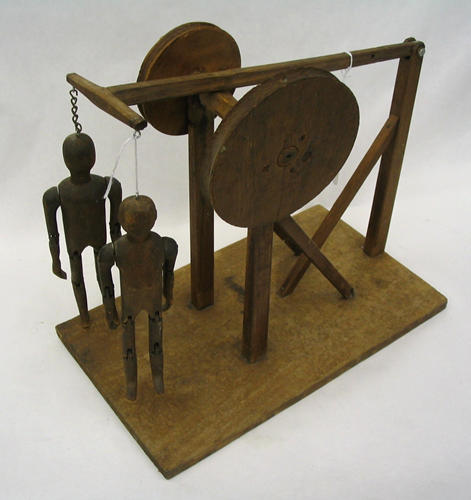 Other
dolls may be held by strings above the plank rather like a puppet. In fact a puppet with
loose wooden feet makes an ideal jig doll. Other
dolls may be held by strings above the plank rather like a puppet. In fact a puppet with
loose wooden feet makes an ideal jig doll.
Other mechanisms can make the doll 'dance' up and down such as a clockwork motor or
electric solenoid vibrating a metal disc upon which the doll is held; there used to be one
of these in the window of the 'Mechanical Cabaret' in Covent Garden, London, now alas
closed and moved to Southwold Pier; ur by a
clockwork driven vibrating rod inserted into the body of a tin-plate doll with the feet
resting upon a fixed metal disc. I have a brand new tinplate duck with an umbrella that
jigs up and down on a drum - possibly made in Germany.
Or even trickling dry sand can drive a paddle wheel that in turn
vibrates a platform can make a static doll dance. Ron
Fuller used to make these, and they may be seen on the Mechanical Cabaret web site, and in
the accompanying YouTube video - Dancing
Man Sand Toy.
And here's a Sand Motor that runs a
Dancing Monkey from Popular Mechanics - May - 1930.
There was even a type that danced on an old fashioned wind-up phonograph
or gramophone playing a 78 rpm record; the vibrations from the record groove caused a
platform to vibrate, and thereby the doll's the feet, legs and arms to 'jig' around. See: the Edison
Gramophone Company and the National Toy Co.
| Where Can You See Jig Dolls?
|
Jig dolls can best be seen
at Folk Festivals usually accompanied by a band of tame musicians. Jig dolls can usually
dance to hornpipes, reels, jigs (of course!!), and even waltzes. Sometimes they dance as a
couple.
There are some shots of
jig dolls performing at the Reading Cloggies Festival at Tony Barrand's Digital Video Research Archive
of Morris, Sword, and Clog Dancing at Boston University and search for 'doll'.
Of course there are also many clips at YouTube,
again use a search term such as 'jig dolls'. Here are six clips:
A clip of "marionettes a la planchette" filmed by Chris Brady
outside Cologne Cathedral in December 2008. |
A quintessentially English scene. The dolls were made by Bernard Pilgrim. For info. on the amazing
organs see: John Smith - Busker |
Another homely English scene in an old cottage in Sutton,
Sussex, with Rob & Gillian Guest and 'William' expertly dancing to pipe and tabor. |
'Henrietta' the Dog with MaryLee - the little kids' music specialist!
Limberjack made by Piper Grove; and see Limberjacks Dancing Songs.
Also try Henry the Dog
with Nancy Stewart. |
A clip of a performance by Val Knight who makes her dolls really dance
at the Reading Cloggies' Festival in 1983. Val is one of the few collectors of jig dolls
in the UK. The musician is the late Simon Knight. |
A second clip of Val Knight and her duet jig dolls with the late Simon
Knight playing Irish box (far left rear corner). This was at a jig doll gathering in the
1980s when over 100 dolls were on exhibition. |
|
|
I guess many folkies know the song "Seth Davy" written by Glyn
Hughes, of an old man who used to busk at the the head of Liverpool Pier with his three
dancing dolls. When he dies his dolls get thrown away and the 'plank went to mend a back
door.'
"The Ballad of Seth
Davy" by Glyn Hughes (ca.1959) of Liverpool, England [1932-1972]. It is
otherwise known as "Whiskey on a Sunday."
Seth Davy is mentioned by Ray Costello in Black
Liverpool: The Early History of Britain's Oldest Black Community 1730-1918 as
"another black street entertainer...a West African often seen in the Scotland Road
area of the city accompanying his cheerful songs with a dancing puppet show." Glyn
Hughes recorded the song for one Fritz Spiegl about 1959, and amazingly, some years later,
Fritz Spiegl discovered some old lantern slides of Liverpool scenes one of which featured
a group of children watching a black man in a bowler hat making some wooden dolls dance on
a plank. The scene can definitely be identified as being near outside the Bevington House
Hotel in Liverpool. All this information comes from the late Fritz Spiegl's Liverpool
Street Songs and Broadside Ballads published by the Scouse Press.
There are some threads about 'Seth Davy' on Mudcat: 1 / 2 / 3 / 4, and here FSC Notes |
1. He sat
on the corner of Bevington Bush[1],
Astride an old packing case,
And the dolls on the end of the plank went dancing,
As he crooned with a smile on his face.
CHORUS: "Come day, go day. Wish in me heart it was Sunday.
Drinking buttermilk[2] all the week; whisky on a Sunday."
2. His tired old hands drummed the wooden beam,
And the puppet dolls they danced t'gear[3].
A far better show then you ever would see,
At the Pivvy[4] or New Brighton Pier.
CHORUS: Come day go day........ |
3. But in
nineteen-o-two old Seth Davy died,
And his song it was heard no more.
The three dancing dolls in a jowler bin[5] ended,
And the plank went to mend a back-door.
CHORUS:"Come day, go day........
4. But on some stormy nights, down Scotty Road[6]
way,
When the wind blows up from the sea,
You can still hear the song of old Seth Davy,
As he croons to his dancing dolls three.
CHORUS: "Come day, go day........ |
[1] Bevington Bush = an area of Liverpool, a formerly
thickly wooded area between Bevington Hill and Everton Hill which at one time had a pub
called "The Bush" outside which Seth Davy busked.
[2] buttermilk = the tart liquid left behind after churning butter out of cream.
[3] t'gear = the gear, a Liverpudlian expression for fashionable clothing; Seth Davy's
dolls were fully clothed
[4] the Pivvy = the Pavilion Theatre on Lodge Lane in Liverpool [thanks to Gwil Jones,
Liverpool for this] (See: The Pivvy)
[5] jowler bin = simply a refuse bin, normally located in the alley at the back of the
house.
[6] Scotty Road way = refers to Scotland Road in Liverpool.
|
The Dubliners - 'Whiskey On A Sunday' or 'Seth Davey'
You can't beat The Dubliners' Ronnie Drew taking the lead vocals
in this song. |
| Links
|
o
Bernard Pilgrim - kimbo18@blueyonder.co.uk -
makes wonderful dolls by private commission only.
o Chris Harvey - makes wonderful jig dolls of many types
some in side/club kit specially commissioned by morris or clog dancers - site also
includes videos of the dolls dancing.
o Cyril Hobbins - HobbinsC@aol.com - jig dolls of many types including a
unique jigging mule called 'Hobbin Dobbin,' he is a no-tangle puppet that can dance on a
board - also 'Marrionett's-a-la-Planchettes,' the large Jig Dolls that are suspended
from a long line attached to a musician's knee - also designs and make Folk Art Whirligigs
- author of Traditional Toys:
Their History and How to MakeThem - Jig Dolls (Feb. 2007), see
pages 81 to 82.
o Goff Evans (RIP) - made many limberjacks
including a Mr.Jollyboy
(modern repro.), a Santa
Jack, and a Spudhead,
as well as a dog and a frog - these are well described in Goff's
publicity leaflet (kindly sent to me by Chris Harvey) - these are now being sold by Harperscraft.
o Joe Pattison - joe@tudcot.fsnet.co.uk - makes wonderful
dolls by private commission only.
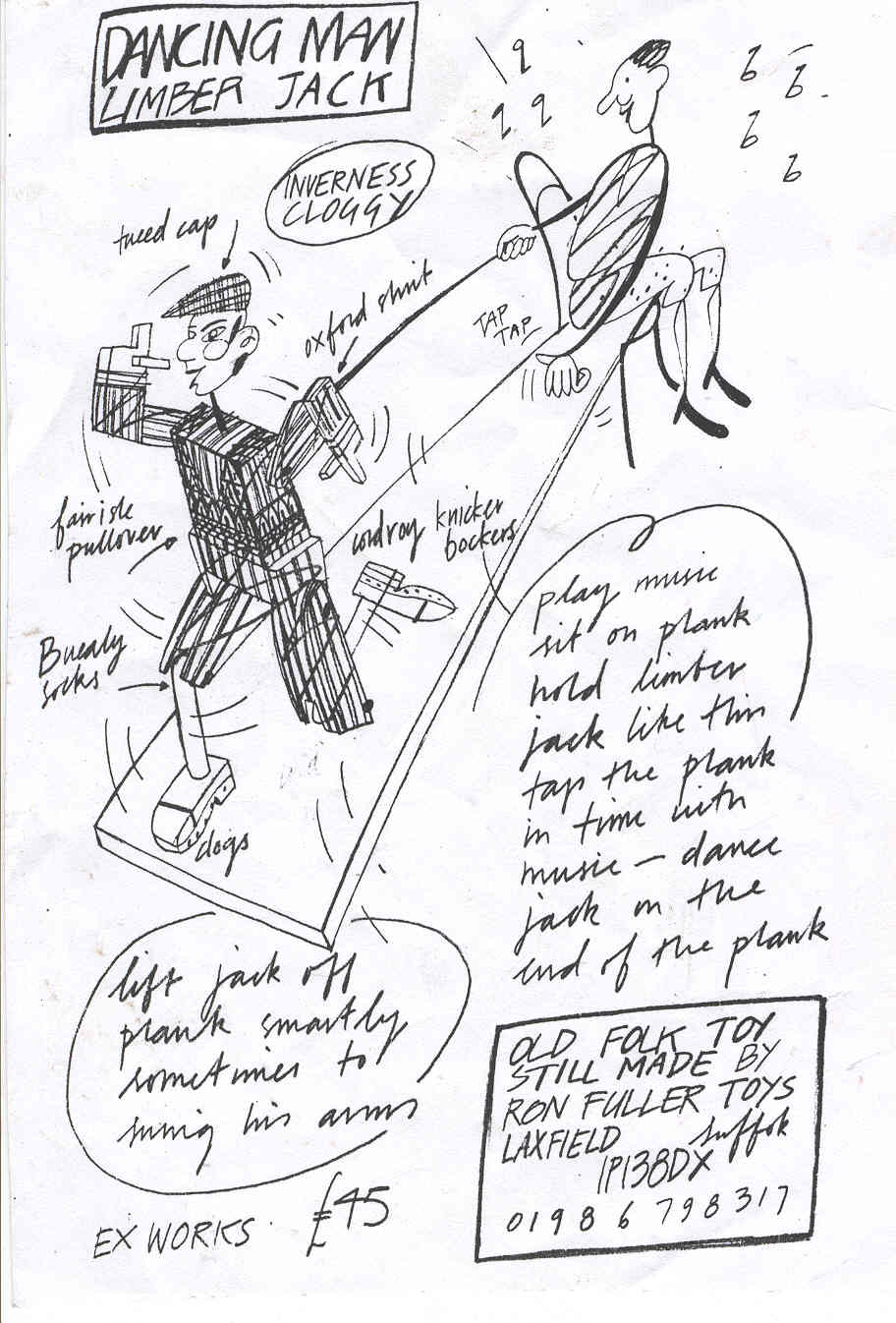
o Ron Fuller
- Laxfield, Suffolk IP13 8DX - makes wonderful dolls by private commission only.
o Ted & Kath Beresford's Puppets - makers
of some of the most delightful jig dolls and puppets.
o Books
 o
'The Brightest of Entertainers' by
Pat & Rennie Pickles is the only known book specifically about jig
dolls. Buy it online at: East Anglian
Traditional Music Trust Online Shop. A new revised edition is in preparation for
publication in 2010. o
'The Brightest of Entertainers' by
Pat & Rennie Pickles is the only known book specifically about jig
dolls. Buy it online at: East Anglian
Traditional Music Trust Online Shop. A new revised edition is in preparation for
publication in 2010.
o Dolls in Canada -
Instructions p.112
/ 113 / 114 / 115 [pages may
not always show].
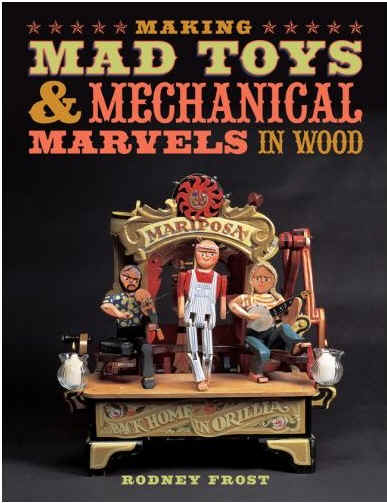
o Making
Mad Toys & Mechanical Marvels in Wood by Rodney Frost (Oct 2007)
o
Traditional Toys: Their History
and How to MakeThem - Jig Dolls by Cyril Hobbins (Feb. 2007),
see pages 81 to 82.
o Whacky Toys, Whirligigs
& Whatchamacallits - Limberjacks by Rodney Frost (2002), see pages 9 to 22. Also
see this Dancing Limberjack
on YouTube
o Google
Books - e.g. a search using "dancing doll" or
"limberjacks" etc. -
lists many books referencing jig dolls (or whatever), but sadly due to copyright
restrictions few allow the full texts to be viewed.
o UK
Sources
o
Abbey House Museum & Kirkstall Abbey,
Abbey Road, Kirkstall, Leeds, West Yorkshire LS5 3EH. Has a "busker's jig-doll, with
red hair, yellow face and blue body, legs below knees of striped tin, clog-like feet; the
puppet was held by a horizontal rod fixed to the middle of back and 'danced' on a wood
board held by the busker sitting and holding the rod between his legs. c. 1900."
o Bethnal Green Childrens'
Museum in East London. This is now part of the Victoria and Albert Museum. They used
to have a number of jig dolls and mechanical 'jiggers' on show, but since a big revamp by
some local 'fine arts' students (armed with a Lottery grant), most of these seem to have
been relegated back to the store room. They do have a standard-type Mr. Jollyboy and box
still on display though. It is also rumoured that they have a doll made in the trenches of
World War I, carved to represent a "Tommy Atkins" (not on display). It would
probably be safe to say that the dolls that they have are never 'danced' out.
o Blaxhall Ship (public house) - Jig Doll
Competition Was held on Sunday March 15, 2009. Entry open to all comers. Prizes and
medals and as much free beer as the competing dancers could drink. Musicians of varying
competency present but owners could bring his/her own accompaniment. This may be repeated
in 2010.
o Chris
Harvey's Jig Doll Circus, includes videos of jig dolls made by Chris, and also a tutorial page on how to 'play' them.
o Cliffe Castle Museum,
Keighley, Yorkshire has been reported by the East Anglian Traditional Music Trust to
have one of the earliest jig dolls yet discovered. This is one from the
Victorian Great Exhibition at the Crystal Palace dating from 1851. "It is a
female figure dressed in skirt, petticoat, bodice and shawl." A request for a picture
has been ignored.
o 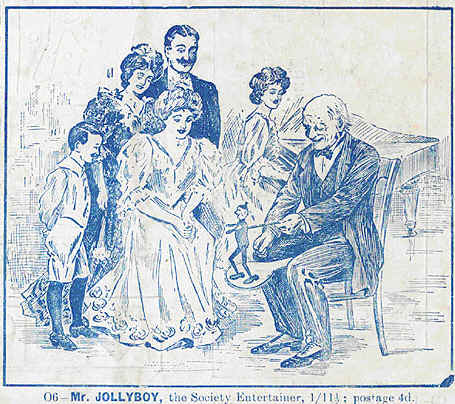 Copland & Lye's 1909
Christmas Gifts Toy Catalogue, Libraries Information and Learning, Glasgow City
Council. It features a Mr. Jollyboy jig doll at 1s 11½d (postage 4d) - [approx. 10p /
1.5p in today's currency]; and a Happy Fanny dancer (suspended
from a string) at 10½d (postage 3d) - [approx. 4p / 1.5p]. Copland & Lye's 1909
Christmas Gifts Toy Catalogue, Libraries Information and Learning, Glasgow City
Council. It features a Mr. Jollyboy jig doll at 1s 11½d (postage 4d) - [approx. 10p /
1.5p in today's currency]; and a Happy Fanny dancer (suspended
from a string) at 10½d (postage 3d) - [approx. 4p / 1.5p].
o East Anglian Traditional Music Trust - Big Jig.
Sometimes holds gatherings of jig dolls and their owners.
o Gallery05
o Lotzdoll
o Mechanical Cabaret - sand toys incl. Dancing Man Sand Toy on YouTube.
o Museum of the Home (recently closed), 7
Westgate Hill, Pembroke, Pembrokeshire SA71 4LB. Had "five jig dolls (or busker's
puppets)." Their whereabouts are now unknown.
o Rhythmdancer - includes a
Quicktime film
o Toypost
Warwick
County Museum Service. Recently Cyril Hobbins emailed: "Last year [2009] my large
collection of old and interesting wooden toys, dolls and games, was purchased by Warwick
County Museum Service, together with my huge research library. They are now permanently
available to students and researchers by appointment; for the past year many have been on
display in a dedicated room. The collection contains one very old and beautiful 'Folk Art
Jig Doll' plus others purchased from eBay and made by myself."
o Woodspinners
o Youngsters
carve puppets for Skipton's Festival Jig. A new generation of the jig doll – the
folk art puppet which has nearly becoming extinct – will populate Skipton Puppet
Festival next month. “The Skipton Skippers”, created during workshops with year
six and seven girls who will attend Skipton Girls’ High School in September, will be
seen doing a mass jig at the festival hub site on the Coach Street car park. Craven Herald
Pioneer - 7th August 2009.
o Australian
Sources
o
The Bush Music Club Inc., Sydney -
Australia's oldest folk club. 'This article about 'Jig Dolls' was written by David Johnson
and originally published in Singabout #58, December 1986, p. 51.
o Canadian
Sources
o
Dolls in Canada
by By Marion E. Hislop, Dundurn Press Ltd (1997). Includes instructions to make a step
dancing doll [pages may not always show].
o Érablière
du Lac-Beauport - French
o Érablière
du Lac Beauport - English
o Faire Tyme Toys.com Dancing
man, horse, pig, bull, sheep, chicken; includes plans to make them, and videos.
o Johnyboy - Bonhomme gigueur - with
animation & video
o Les
Sortileges.com - folk and step dance school, they used to sell limberjacks
o Musantiqua Inc -
Limberjacks
o Lois Siegel -
Fiddle Farmers - Unusual Instruments - scroll down for 'Dancing Limberjack'
o Luc Laroche - Conteur Québécois
o Musantiqua.ca - Limberjack
o Rigadon - 'Ti-Jean' - mascot of the
Rigadon series.
o Rigadon - Chantons - "The CD
winds up with lively traditional tunes to make both you and the "Ti-gigueux"
want to dance!"
o USA
Sources
o
AndysFrontHall.com -
Limbertoys
o Asheville News - Lumberjacks
o BargainJohn.com - Black
Memorabilia - 'Dapper Dan Dancer' Wooden Dancing Toy.
o CivilWarPreservations
- Dancing Dan
o CivilWarPreservations
- Jazzbo-Jim
o Digital
Video Research Archive at Boston University - then search for 'doll' (singular)
o Elderly.com - Limberjacks
includes plans to make a Limbermule
and a Limberjack
o Etsy - Limberjack Man
/ Limberjack Dog / Limberjack Frog
o Etsy - Music CD Sing
and play your limberjack! These folk songs are just the right tempo and rhythm for
Limberjack dancing! Sing along and play with the CD!
o FindArticles
- Remnants of a Lost Era: Appalachian Primitive Dolls
o Gustafsonzook - Limberjacks
o Hakes - Auction
o Hendersonville News -
Lumberjacks
o Keith Young - include
Quicktime movies and Dressed up Limberjacks.
o Lewis
Lamb - traditional Appalachian fiddle player and limberjack whittler. Makes wonderful
dolls by private commission only.
o Maggiesansone.com
o Makers of Magic: The Faces of Carolina Puppetry
- A documentary that introduces some of the talented puppeteers who live in the Carolinas.
Features Clyde Hollifield (a maker of limberjacks), and others. Traces use of puppets from
simple Appalachian toys to giant street puppets.
o Making-Toys-Mechanical-Marvels-Wood
- Amazon.com Includes instructions for making jig dolls.
o Popular Mechanics
- 1930 - p.839 - Sand Motor Runs Dancing Monkey
o Popular Mechanics
- 1958 - p.147 - Electronic Tapping Tim
o Mr.Tap'n'Go made by the Triple R Machine
Co., Burbank, CA.
o Mr.Tap'n'Go - Japan made by
the Triple R Machine Co., Burbank, CA.
o MyDearDolly.com
- 11 1/2" tall, early, black dancing stick man worked by a metal rod, which is
attached to the back. Figure is completely jointed and entirely made of wood with painted
features and clothing. Very unusual toy is completely original and a fine example of a
late 19th century folk toy. Perfect cond. with no repainting.
o Nancy Music.com -
Henry-the-Dog - with song and video (delightful).
o Nan Hoffman.com - includes a frog,
dog, and dinosaur!
o NLEINDEX
- An excellent index of magazine articles on how to make your own jig doll.
o Planet of the Geeks.com - Making a
Limberjack.
o Riverlark.com Our limberjacks are
made of cherry, a native American hardwood, and come with a stick, tapping board and
instructions.
o Rochester Folk Art
Guild - Limberjacks
o Ross Sutter
Recordings - Cherry or walnut limberjacks. Also does limberjack building workshops for
schools or other groups.
o Story-Lovers - Limberjack
o TCpuppet
o Terre pis Ciel-
traditional arts master Fred Légère usually plays the
harmonica to accompany his dancing horse and his "t-bonhommes de bois" which he
has carved.
o ToysFromTimesPast
o Trocadero
o Videos and Films (UK/USA)
o "Appalachian Journey" - Alan Lomax
travels through the Southern Appalachians investigating the songs, dances, and religious
rituals of the descendents of the Scotch-Irish frontiers people who have made the
mountains their home for centuries. Features a limberjack and traditional step dancing.
o 'Pat Pickles' Jig Doll Party' - [home
movie video - approx. one hour long - email me for details - CJB.]
o YouTube
(excellent examples of how not to play a jig doll / limberjack and a few good
ones!!)
o GoogleVideo
(more excellent examples of how not to play a jig doll / limberjack and a few good
ones!!)
o Wikipedia
/ Folkopedia / Folkipedia
o
Jig_doll / Limberjack (Wiki) - Both entries are
poorly written, with little research done. Entries have been vandalised by self-appointed
highly-opinionated arrogant know-alls. I have given up trying to update it only for
someone else to come along and change it to suite his/her own agenda.
o
Jig_Dolls (Folkopedia) - Little
text, allocated to incorrect category.
|