|
Please download the latest flash player for your browser: Click for NZBC Radio Programme |
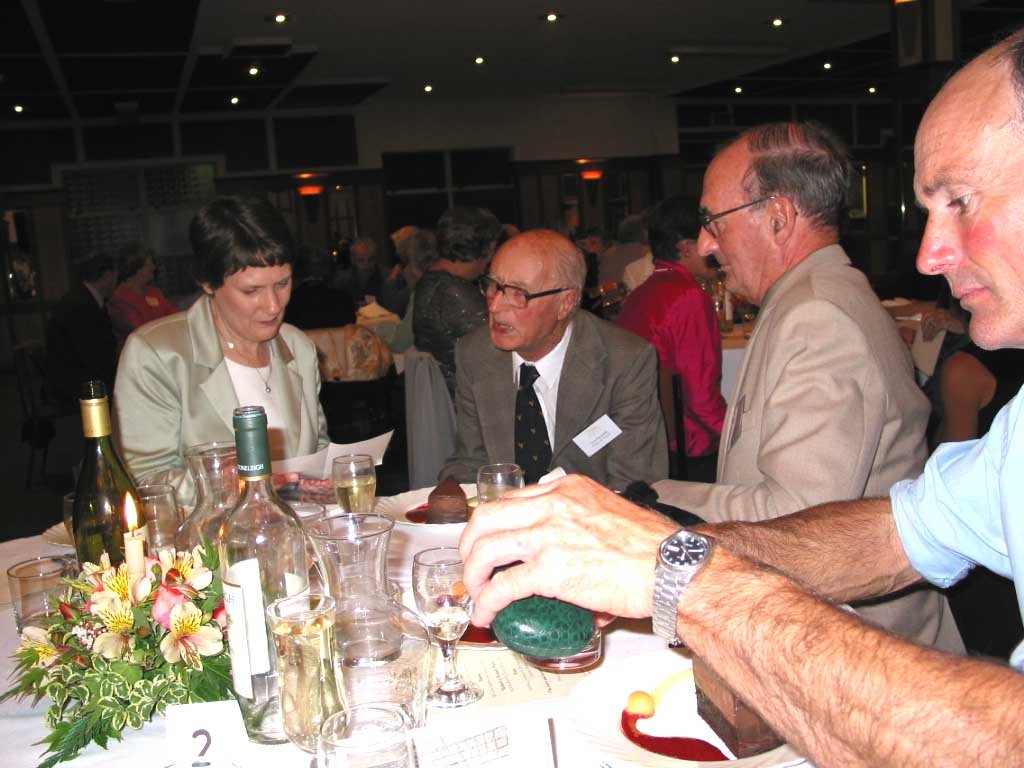 Helen Clark, the then NZ PM, discussing Pearse with Geoff Rodliffe and the 2004 replica team. |
||||||
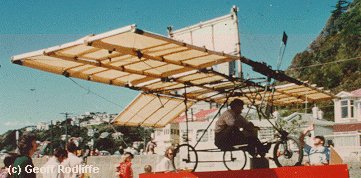
"The Riddle of Richard Pearse" - 1975This is the docudrama mentioned below during which the horses that were towing the replica plane across a field suddenly bolted with the plane taking off behind them - and when despite all the cameras around no-one managed to get a recording of it 'flying.'!! The film can be viewed at the NZONSCREEN website at: The files (3) can be downloaded using FlashGet or Orbit.
Eyewitnesses
|
||||||||
ExhibitionsThe Museum of Transport and Technology (MOTAT) in Auckland has a large collection of Pearse relics including parts of the original engines, and the almost completed vertical take off 'utility' plane (thought to be Pearse's 3rd). Unfortunately the latter has been reported as being severely damaged by contractors during recent renovations (in 2010); and it has been reported that the displays of Pearse are now not so easily viewable by the public. There is very little information about his remarkable achievements on the MOTAT website although there is this free Fact Sheet - Richard Pearse One of the more recent Pearse 'flying' replicas was exhibited at Shuttleworth, UK - 2003 The Pearse 'flying' replica was also exhibited at Flambards, UK - 2003. There is a permanent display there devoted to Pearse's achievements. The Timaru Museum in South Canterbury NZ is interested in acquiring and exhibiting as many Pearse exhibits as possible. Also too there is very little information about his remarkable achievements on the website. Timaru is near Waitohi where Pearse made his historic 'flight(s)' possibly as early as 1902/1903. Christchurch City Libraries web site has a good page about Richard Pearse. |
||||||||
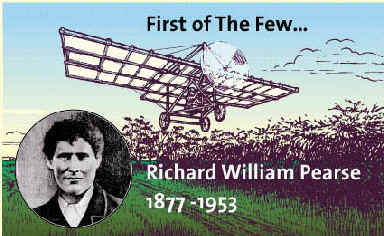
RICHARD WILLIAM PEARSE 1877 - 1953
|
WHO FLEW FIRST?by Geoff Rodliffe (c)1990
|
 | Pearse is recognised by some as the first man in New Zealand to lift off from the ground flying his home built powered aircraft. |
| But his achievements and the flights made in 1902/1903 at Waitohi in New Zealand have little or no similarity to the well-documented flights which took place by the Wright Brothers at Kitty Hawk on the 17th December 1903. |
| However Pearse must be the first and the only aviator who had at that time designed his own unique internal combustion engine; and designed his own aircraft (pre-dating the microlight by about seventy years). |
| He built both the engine and aircraft in his secluded elementary workshop with minimal assistance, enabling him to make a number of 'flights' piloting the aircraft himself. |
| Pearse has been recorded as having stated he never flew with his first aircraft. Although he had been established in his own secluded workshop building engines and aircraft for five years previous to the year 1903, it has not been possible to establish how many aircraft he had built and experimented with before he was seen flying in 1903. |
| Pearse in a letter to the press mentions the year 1904 when he began studies to achieve aerial navigation, and that true aerial navigation was not achieved until 1905. |
| There are accounts of a smaller machine preceding the better known flights of 1903 followed by a larger circular aircraft, another one of which little is known about, but which was built after he had moved to a very quiet secluded spot at a place called Milton. |
| Many years later the larger helicopter style, the original example of this circular aircraft, is now on display at the Auckland Museum MOTAT. |
| The various engines were equally numerous: relics of the 1900 two cylinder engine exist, a later more advanced four cylinder engine, an undiscovered multi-cylinder engine supposedly used at Milton, an engine for agricultural purposes, and a motor cycle engine which he used on the roads. And finally the very complex powerful engine fitted to the helicopter machine. |
| There were a number of pioneering features of the first known aircraft which are in use in modern aircraft even today. Pearse's advanced design used a tricycle landing gear, which would only come into general use thirty years later. And his aircraft really resembles the microlights which would only be introduced almost seventy years later. |
| In particular, other early aviation pioneers such as the Wrights used primitive wing warping, or 'side tipping' as Pearse described it, to attempt to control an aircraft in flight. However Pearse introduced a flap system in place of the usual aileron which would avoid twisting the wing. This closely resembles the method of control now generally used in high speed aircraft. |
| And unlike the Wrights, Pearse wisely decided to eliminate the need for an engine with a flywheel. He did this by having a propeller firmly bolted onto the crankshaft, thus saving considerable weight. Arriving at the correct design for the propeller was in itself a monumental task. However the choice of direct drive was obviously justified: from 1906 onwards this method came into general use. |
| The remains of Pearse's pioneering aircraft, engines, and the 'working' replica of his first aircraft, together with his unique motorbike, used to be seen at MOTAT, the Museum of Transport and Technology, Western Springs, Auckland, New Zealand. However recently the new management regime at MOTAT has relocated them into dusty corners making public viewing difficult. |
LATER RESEARCHby Geoff Rodliffe (c)2006
|
| Wild and inaccurate statements have been publicised from time to time concerning Richard Pearse's achievements in the field of aviation. However no responsible researcher has ever claimed that he achieved fully controlled flight before the Wright brothers, or indeed at any time. To attain fully controlled flight a pilot would have to be able to get his plane into the air, fly it on a chosen course and land it at a predetermined destination. Obviously Pearse's short "hops" or "flights", whilst they established the fact that he could readily become airborne, did not come within this category, but neither, for that matter, did the first powered flights of the Wright brothers in December 1903. The Wright brothers, however, had the resources necessary to continue their experimentation until they achieved fully controlled flight. |
| It has been suggested that the term "flight" should not be used in connection with Richard Pearse's achievements. Nevertheless, from the accounts of numerous eyewitnesses it is obvious that his plane did become airborne, therefore that is exactly what the term is intended to convey wherever it is used in this publication. |
| In fact, little recorded information is available concerning Pearse's early flights, and but for the discovery of a strange mock-up aeroplane and its extraordinary engine it is probable that no research would ever have been commenced. This aeroplane and some written material (most of the material found in Pearse's Christchurch home after he died had been destroyed) were collected and presented to the Museum of Transport & Technology in Auckland, where the plane is now exhibited. |
| In 1958 an expedition was made to Pearse's farm in Waitohi, where, in a rubbish tip nearby in a dry area of the Opihi riverbed, amidst a mass of brambles and embedded in clay, a four cylinder engine was discovered. At the time this was thought to be Pearse's first engine. However, his first engine was later discovered during a search in the same area in 1971: this was the two-cylinder engine mentioned in his first patent application. |
| It has been suggested that Pearse only used one aeroplane between 1900 and 1909 but with considerable modifications, and Pearse's letters confirm that impression. However, if that was the case, the modifications must have been so extensive that there was no similarity between the plane of 1903 and that of 1909. We interviewed three witnesses who had on two occasions in 1910 inspected a large, unwieldy, circular machine in a corner of Pearse's paddock, which they declared was completely different from the one used in earlier years. Mr Rav. McAteer, in a letter to Mr George Bolt dated 3rd September 1959. stated: "We also knew that he built more than one plane, but as the Pearses' farm was a neighbouring one this then would not surprise you". As Richard Pearse left the district in 1911 the two planes referred to obviously were built during preceding years. |
| On the strength of these testimonies, and for the practical consideration that the large, unwieldy plane of 1909 was not likely to have carried out the manoeuvres described by witnesses. we came to the conclusion that there must have been two quite different planes during that period. |
| The first investigations into Richard Pearse's aeronautical activities were carried out by the late George Bolt, assisted by other prominent New Zealand aviation experts. Mr Bolt and Mr Harold Cederman interviewed a number of witnesses who had seen Pearse attempting to fly, and some who had seen his aircraft in flight. From these researches, George Bolt was quite convinced that Richard had actually flown his machine. However, there appeared to be discrepancies in the witnesses' accounts insofar as time and place were considered, as it was assumed that all the evidence related to one flight only. Later it was realised that more than one flight had taken place and that several localities had been used. Most of the eyewitnesses were confident that the flights took place in 1903 but a few felt equally certain that they had seen Pearse's plane in the air as early as 1902. |
| As the investigations proceeded public interest was aroused and premature statements began to be circulated and published in New Zealand and overseas to the effect that Pearse's first flights had definitely pre-dated those of the Wright brothers. |
| At about this time two of Pearse's letters to the press came to light. In the first, dated 10th May 1915, he stated: I started out to solve the problem (of aerial navigation) about March 1904. The Wrights started at about the same time". In the second letter, dated 15th September 1928, he wrote: "I started my experiments on aerial navigation about February, 1904". |
| This subject is dealt with in detail by Gordon Ogilvie in his book: "The Riddle of Richard Pearse", on page 71 of which the following passage appears: |
| "By the time Pearse came to write his letters he must have known that the Americans had been working on the problems of flight since 1899-1900. Therefore when he has them setting out to "solve the problem" in 1904 he must be deliberately disregarding all their preliminary experimentation. It is not unreasonable to argue, then, that he was treating his own preparatory work similarly. And his early efforts could just as easily date back to 1899, as there is evidence to suggest. |
| At the time of George Bolt's investigations, however, as only part of the evidence had been recovered and examined, he felt bound to accept Pearse's own statements that 1904 was the year of his first attempts at flight, and he published his findings accordingly. This caused a temporary lull in the Pearse / Wright controversy, and before George Bolt could complete his researches, he died. The book which he had hoped to write on the subject was not written, but a summary of his findings, together with letters from witnesses, is to be found in the archives of the Walsh Memorial Library at the Museum of Transport and Technology. |
| In the mid 1960's Mr Gordon Ogilvie was teaching at Pleasant Point High School and became fascinated by the story of Richard Pearse. For some years he followed up all possible leads. interviewed witnesses and led the expedition which recovered Pearse's first engine from the Opihi river bed. His book "The Riddle of Richard Pearse" published in 1973 contains a full and accurate account of all research carried out by himself and others up to that date. |
| The late Joseph Coll, a resident of Waitohi, recalled two visits he made with two others boys, Maxwell and Baxter, to the vicinity of Pearse's workshop. where they examined his second plane. Their first visit was uneventful but aroused their curiosity to such an extent that they decided to make a more thorough investigation the following day. They were aware of the fact that Pearse had been very ill for some time and they did not therefore expect to be disturbed; however, when a very white face appeared over the top of the hedge, although Pearse did not speak to them, they immediately ran away. |
| Mr Coll commenced his researches into Richard's work at about the same time as Mr G. Bolt. The fact that he knew many of the residents of the Waitohi district was of great assistance to him and he was able to trace a number of people who had moved from there to other parts of New Zealand. His memory was exceptional and he was able to link the dates and verify the accounts of people to whom he had spoken. Whilst at first some of his statements were regarded with suspicion. It was later realised that most of his facts were confirmed by information from other sources. |
| In the mid 1960's Mr Coll wrote to the author suggesting that he should interview the surviving eye witnesses in an endeavour to establish more exactly, if possible, the dates and places of early flights, and especially to evaluate any technical material that might be volunteered. -The author contacted Mr Tom Bradley of "The Timaru Herald", who had worked with him on aviation in England and was now living in Pearse country. Mr Bradley was able to interview many of the witnesses and accompanied Mr Ogilvie when the first of Pearse's engines was recovered from the river bed. |
| Since that time research has continued, with the valuable assistance of many individuals and organisations. When Mr Bolt commenced his investigations some of the eyewitnesses had already died and many have died since, but even at this late date further information occasionally reaches us. Small and seemingly unimportant items may assist in completing our records, therefore the Museum of Transport & Technology would like to hear from anyone who can add to, confirm or correct the facts and conclusions contained in this publication. |
Robert Gibson
| Among the many witnesses to Richard Pearse's early flights the one most frequently interviewed was probably Robert Gibson; who first visited the Museum of Transport and Technology when he heard of the arrival there of Pearse's last plane. It was also at M.O.T.A.T. that he was interviewed by N.Z.B.C. personnel, when a tape recording was made. When seen at his home at Shelley Beach on several occasions during subsequent years, Mr Gibson was always very definite and clear in his account. |
| By 1971 he had moved and after a considerable search was located in Blenheim, where a television team comprising Keith Aberdeen (scriptwriter) and Maria Hill (research) interviewed him. This filmed interview is now in the archives at M.O.T.A.T. |
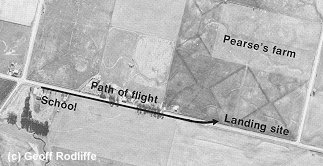
| Mr Gibson described arriving with his brother Ramsey at the paddock where Pearse was attempting to fly. This was one to two miles from his workshop and he had apparently transported the machine with the aid of two horses and a dray. On the first attempt the plane, which was heading in a westerly direction, ran into a gorse-covered hollow where the propeller was apparently damaged. The boys pulled the machine back about 50 yards, and after Pearse had straightened the propeller and carried out other small repairs he and the boys gave the ground a thorough inspection. Then he made his second attempt, the engine started with a frightening noise, the boys commenced pushing and as the plane gathered speed they were left behind. They watched as the machine turned over the cliff to the right and flew up the river until it disappeared behind a pine plantation. |
| (It is probable that Pearse chose a westerly direction for both flight attempts in order to take off into the wind. If this were so, on the first attempt the plane could well have veered to the left, as described on other occasions, as he would not have deliberately chosen to head towards the clump of gorse bushes. On the second attempt the same thing could have happened, as here again he would not have chosen to fly directly towards the cliff edge and over the fringe of willow trees, which rose 12 ft. above the level of the paddock. It must have been a frightening experience to find himself 40 ft. above the river bed and his only option would have been to turn to the right to find a clear space for landing.) |
| Mr Gibson recalled that the boys ran diagonally across the paddock to meet a very wet Richard scrambling up a track from the river. He also remembered his brother being punished by their mother for taking him to see the flight. In common with many of her contemporaries, she believed that the aeroplane was the work of the Devil. |
| Mr Gibson further recalled an incident in France during World War 1 when he was involved in a fight as a result of his claim that he had seen a New Zealander fly before the Wright brothers' first flight. |
| Concerning the date of this flight, in a letter to Mr Joseph Coll, he had this to say: "The time of the flight was Easter school holidays, 1903. This took place before Easter or Easter Saturday. My brother Ramsey, who took me over on his cycle, went up the Mackenzie Country to work immediately after Easter. As you know, in those days when one turned 14 it was work". |
| Mr Gibson also possessed a photograph showing Ramsey skinning a dead sheep in the Mackenzie Country after the great snowstorm, which occurred in July 1903. |
| Mr George Bolt mentioned another witness who gave an account of a flight of about a quarter of a mile along the bed of the Opihi river at about the same time. Mr Arthur Tozer also recalled that as a young lad he was driving a buggy over the riverbed road when he was startled by a plane flying overhead. These three witnesses could have been describing the same flight. |
Amos Martin
| Mr Murray Reece, the well known television producer, while filming in the Waitohi district in the late 1960's, by chance met Amos Martin, who told him that he had witnessed one of Richard Pearse's early flights. As a result of this meeting Mr Reece returned to the district in 1971 and instigated research into the Pearse story, which culminated in the production of a television film by the Christchurch studios a few years later. |
| The interview between Mr Reece and Mr Martin was recorded on film and this is now held at M.O.T.A.T. In the film Mr Martin described very clearly the flight which he saw on the 2nd May 1903. The same information is contained in letters to Mr Joseph Coll, in which he stated that he was able to fix the date because it was pay day and pay day was on the first Saturday in the month. On that day he was cycling past Richard's farm on the main Waitohi Road at some time between 2.30 and 4.00 p.m. when he saw Richard taxiing his plane and having some trouble with the steering, before taking off and finally landing on a high gorse fence. In a later interview he went into greater detail and mentioned that he was returning from chaff cutting on a neighbouring farm when he noticed this weird construction in Pearse's paddock composed of, bamboo rods and bike wheels. It taxied 50 yards, rose 10 to 15 ft., flew 50 yards, then crashed into a hedge. He then added: "I got on my bike and hightailed off!" |
| Amos Martin left the district and travelled south in August 1903, to work in a coalmine, so that this flight must have occurred earlier that year. |
| Mr Thomas Hide, in a letter to Mr Cull dated 12th November 1966, also referred to Amos Martin's account of this flight. |
Frank Biggs
| Frank Biggs remembered his teacher, a Mrs Ritchie of Fairview School, telling the children that Pearse had flown. From his own recollection he confirmed that the flight would have taken place between 1902 and 1904. In a letter to Mr Joseph Coll he stated: "Now regarding the flight, I can remember it pretty clearly. It would be late April or early May, spud digging time. Mr Martin, as he witnessed the flight, would be pretty correct with his statement". |
Thomas Edwin Hide
| When interviewed by Mr Joseph Coll and subsequently by the author, Mr Hide clearly recalled being at Orr's blacksmith's forge with others when he heard that Pearse had flown his plane that day and landed on top of the hedge. Mr Hide went along to see if anyone had been hurt. Later he heard that Pearse had been taken to hospital in a dazed condition. During that evening at the usual weekly gathering in the library and at the meeting of the Morris Tube Rifle Club, all the talk was about Pearse's flight that day. |
Hugh McCully
| Hugh McCully was a neighbour and close personal friend' of Richard Pearse's, with an intense interest in Richard's experiments in aviation. He himself invented and patented several items of farm machinery. When interviewed by the late Harold Cederman, Mr McCully recalled how Richard had offered to let him fly the plane, but that as he was getting married in the near future it seemed too risky a proposition. (Records show that Mr McCully was married at Temuka on the 17th June. 1903.) |
Ethel Bourn Florrie & Ruth Pearse Nellie McAteer
| Ethel Bourn and her older twin sisters , Elsie and Ellen, were on their way to school with Florrie and Ruth Pearse when the Pearse sisters mentioned that their brother had flown the day before, the 3lst March. At first they were not believed as Ethel and her sisters assumed that it was an April Fool's joke. |
| On arrival at school they told Nellie McAteer. Her route to school lay across hills at the back of Pearse's farm, and, when interviewed, she clearly remembered this conversation and also recalled seeing Richard's plane on the hedge for several days. She believed that the date of the incident in question was 1902 because she recalled being the only one in Standard 7 the following year. Her Education Board Certificate which is still in existence shows 1902 to have been her last official year at school. |
| In any event, the conversation could not have taken place after the 1st April 1903, as the older girls would not have been at school in 1904. |
McLean (nee Crawford) Clifford Crawford
| Mrs McLean was interviewed with her brother, Mr Clifford Crawford, by Miss Anna Cotterill of Television News, Christchurch, in 1976. A copy of this film is now in the archives of the Walsh Memorial Library, together with a letter dated 5th September 1976, from Mr Crawford to the author. Mrs McLean affirmed that she was with her father on the hillside at the back of Richard Pearse's farm when she saw his plane in the air. She was quite certain that the date was Tuesday March 31st 1903. Her farther, when time permitted. used to drive Richard's team and they were close friends. |
| Her brother, Mr Clifford Crawford, remembered visiting Richard's workshop and seeing the twisted and crumpled plane after it had landed on the fence and had remained covered with snow for some days before being moved to the workshop for repairs. |
Harry Brosnahan
| Mr Brosnahan told George Bolt that he remembered Pearse experimenting with aircraft ideas at the close of the 19th Century. He frequently went to watch the building of the aircraft. which took a considerable time. He believed that the first flight took place in the autumn of 1902 just after a very bad flood (confirmed by the Meteorological Office as March 1902). He also recalled several short hops. |
Michael Friel
| Michael Friel was positive that a flight occurred within a year of the end of the Boer War, which of course ended in 1902. His description of the aircraft was identical with the replica machine built for the film. |
D Friel
| Mrs D. Friel informed George Bolt that she saw a Mrs Johnson was an eye witness to the flight flight from the road from a distance and clearly remembered the machine in the air. |
John Casey
| John Casey recalled that he was among a crowd of spectators who gathered in the vicinity of Richard's farm to watch a take off. It was not long after Richard's first flight and the news had got around that there was to be another free show! Miss Crowley, then a teacher at Upper Waitohi school, had allowed her pupils out to see the flight. (The "Temuka Leader" of the 17th September 1903, recorded Miss Crowley's departure from the school). Mr Casey also left the Waitohi district in June 1904, and did not see Pearse again. |
Thomas Wade
| Interviewed by Mr Joseph Coll and later by the author, Mr Wade stated that the first flight took place whilst he was still at school being taught by Miss Crowley. He also recalled that she left Waitohi in September 1903 |
T. (Louie) Johnson
| Mrs Johnson was an eye witness to the flight mentioned above. According to Mr George Bolt, she also gave him a very clear account of Pearse practising in the paddock, and of a flight from the road. She described the aircraft acceleration before take-off as slow and the climb after take-off as slow with a pitching or undulating motion. Mr Bolt noted: "This would tie up with what usually happens to someone taking off for the first time and getting used to the fore and aft controls". Mrs Johnson further described a swing to the left after take-off and the plane landing on top of the hedge, from which George Bolt concluded that the machine must have attained an altitude of 12ft. |
Basil C.H. Bedford Ruby & Flerning Bedford
| Mr Bedford's affidavit states that his father and mother were close friends of Richard Pearse and that they, together with Mrs T. Johnson, were invited by Richard to watch a flight from the hillside above his farm. Warne Pearse was assisting his brother. The plane flew and landed on top of the hedge but Richard was unhurt. According to Mr Bedford's parents, the dog daisies were in bloom and the flight took place three months before his birth on the 6th June 1903. As his parents left the district in December 1903, the flight must have preceded this date. |
| Mrs Bedford's affidavit confirms these facts as they agree with all the statements made to her by Basil Bedford's parents and Mrs T. Johnson. |
W. Barker
| According to Mr Bolt's notes made at the time of the interview, Mrs Barker Remembers flight very well and accurately, describes the movements of the plane in flight, the same as the evidence of Mrs Johnson - viz. shaky, undulating fore and aft and very noisy. She said it had no tail and turned in the air to the left. She and other girls of the time used to go to Pearse's place on Sunday afternoons and watch the progress of the building. |
Michael McAteer
| Michael McAteer, brother of Michael McAteer, was taken by his father to see the plane on a high hedge. He remembers clearly that it was in 1903. because he was then six veers of age, it was just after the harvest and he had started school at Waitohi that year. He also recalled that the plane had no tail. |
| Mr George Bolt commented that several members of the McAteer family clearly remembered the flights as they lived on a farm adjoining Pearse's |
Steve Smith
| Interviewed by the author, Mr Smith stated that he had lived near the tipper Waitohi school during the Boer War and had heard Richard's engine running even late at night. He very clearly recalled seeing the plane on the gorse hedge as his horse refused to pass by, and stated that the plane had almost cleared the top of the hedge, which was about 10 to 15 ft. high. |
Cissie Connell
| Miss C. Connell told the author of a flight attempt which she saw from a haystack adjoining Richard's paddock, when the plane landed on top of a high gorse hedge. Her brother Jack was assisting Pearse at the time. Miss Connell affirmed that Pearse did not actually fly but was at a loss to explain how the plane finished up on top of the hedge. She finally stated that "it just hopped up there" |
Jack Connell
| Jack Connell told George Bolt that he watched Richard Pearse build his aeroplane and assisted him with it when he was experimenting. He recalled flight trials and verified the general engine and plane layout and he stated that certain parts of the engine were made for Richard by Parr & Co. of Timaru, he remembered a considerable amount of ground running and fast taxiing and hopping in the paddock. According to his description, Pearse sat on a sort of saddle under the wing almost in an upright position, that the plane had no tail and that it took two men to hold back the machine when the engine was running. |
William Edgeler
| William Edgeler recalled hearing a terrible noise and seeing Richard's plane careering towards a gorse hedge. This was definitely on the 31st March as his comment that "Had Dick Pearse waited another- day he would have been a proper fool instead of just a bloody fool" remained a family joke for years. (The other April Fool's anecdote was not publicised until some years later.) |
Warne Pearse
| Mr Warne Pearse. Richard's younger brother, told George Bolt that he remembered the building and experimenting done by Richard and something of the construction and materials used in the first plane. He mentioned two flights which took place along the road before the Wright brothers' first flight, one about April 1903 and the other about September 1903. He also recalled that the plane was out of action for some time owing to the need for repairs. In addition to the two flights mentioned, he referred to a considerable amount of fast taxiing and "skipping" along the ground in the paddock. |
C. Davis
| Mr C. Davis told the author that his father definitely saw a flight on the last Saturday in the month either in February or March 1903. Also he saw another flight of 130 to 150 yards in a paddock. |
A. Casey
| Mrs Casey watched the aircraft being built and saw it completed. Her father saw the flights and believed that they took place in 1903. |
Mrs Hart
| Mrs Hart told George Bolt that she saw the machine rise off the ground. |
Mrs Esler
| Mrs Esler remembered her father telling her that he had seen the aeroplane take off and drop on top of the hedge. |
J. Campbell
| Mr J. Campbell of Geraldine remembered flights which he was unable to date accurately. He thought they must have been between 1904 and 1906. |
P. Hullen
| Mr P. Hullen did not see any of the flights but remembered a test stand which Pearse had made to test the engine and propeller.. It was about 10 ft. high. with a swing arrangement upon which the engine was mounted, obviously in order to test the thrust. He confirmed that the construction of the wing was mainly bamboo. |
J. Chapman
| A letter to George Bolt from Mr John Lower of Christchurch stated that Mr J. Chapman claimed to have seen Richard Pearse fly twice, and that on the first occasion the plane hit the fence. |
Dan Connell
| Dan Connell, brother of Jack, was present and helped to hold back the machine for a flight along the road. He was only a boy at the time, still at school, and he believed the year of that particular flight was 1904. |
Harry Stoakes
| Mr Harry Stoakes, a resident of Waitohi, remembered seeing Pearse make two flights in his paddock. He believed this was in 1903 and he was about 10 years old at the time. On the first attempt the machine lifted into the air very briefly, on the second attempt, after some adjustment to the propeller pitch, the plane rose and finished up on top of the gorse fence. The following day Harry Stoakes' sister was riding a horse along the road and on seeing the plane on the hedge, the animal refused to pass. |
Wanaka Hullen
| Miss Hullen recalled being shown, as a child, the plane perched on top of a hedge with gorse poking up through the framework. |
Jean Curry
| Interviewed by Tom Bradley and the Author, Miss Curry recalled that one Sunday her father and Mr McClintock visited Richard's workshop, and when they returned her father said: "If he gets that contraption into the air, he will fall out of' it and kill himself". Her father described the plane is being "all hoop iron and wire". The family left the district in 1899 (reference Land & Survey records). |
| Miss Curry also recalled the strange noises which emanated from Pearse's workshop and which puzzled the neighbours. |
Cecil Wood
| Mr George Bolt interviewed Mr C. Wood, an engineer of Temuka who built the first car made in New Zealand. Mr Wood got to know Richard very well he visited him many times with reference to the construction of his aero engine. This was in 1901 / 1902. He remembered showing Pearse how to make his spark plugs with a central electrode wrapped with mica. He also helped him with the design of surface carburettors. |
William Moore
| Mr Moore told George Bolt that he clearly remembered flights although he was unable to date them. He thought they could have been in 1903. |
Note: Approximately half of the statements were made by witnesses who claimed to have seen the Pearse plane leave the ground. Some saw more than one flight. Most of these accounts were recorded by aviation experts, George Bolt, Harold Cederman and other reliable researchers. Of the remaining accounts some were not first-hand but were statements made by relatives or friends of the persons who saw the flights, and others gave descriptions of the aircraft in the paddock or on the hedge and recalled incidents connected with Pearse's activities.
|
PUBLICATIONS:
|
|
OTHER PEARSE LINKS:
|
Some Other Web Sites:
Other Early Aviation Pioneers:
|
Email: Chris Brady |
Top # Home | |
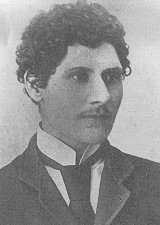 For
the best part of a century, the activities of Richard William Pearse (1877-1953) were
largely unknown outside the small, close-knit, farming settlement of Waitohi, in the South
Island of New Zealand, where he was born and where he flew his aircraft in the very early
part of the 20th century.
For
the best part of a century, the activities of Richard William Pearse (1877-1953) were
largely unknown outside the small, close-knit, farming settlement of Waitohi, in the South
Island of New Zealand, where he was born and where he flew his aircraft in the very early
part of the 20th century. 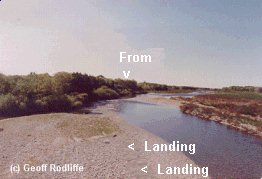
 The
years 1902/1903 date his achieving the world's very first mechanically powered flight(s).
Dating suggest a first flight on 31st March 1903 - the day before April fools
day. Corroborated eyewitness accounts from school children at the time and in their 70/80s
when interviewed, together with other somewhat conclusive evidence from the local school
records, confirm that at least one of his powered flights took place on 31st
March 1903. And there were numerous other trials taking place both before and after that.
His most active flying year was obviously 1903. The dates are mentioned in Geoff
Rodliffe's
The
years 1902/1903 date his achieving the world's very first mechanically powered flight(s).
Dating suggest a first flight on 31st March 1903 - the day before April fools
day. Corroborated eyewitness accounts from school children at the time and in their 70/80s
when interviewed, together with other somewhat conclusive evidence from the local school
records, confirm that at least one of his powered flights took place on 31st
March 1903. And there were numerous other trials taking place both before and after that.
His most active flying year was obviously 1903. The dates are mentioned in Geoff
Rodliffe's 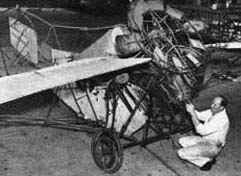 However it was some fifty years later that investigators were alerted to
Pearse's flying activities by the discovery of a roughly constructed 'utility' aeroplane,
his third (see left), which never flew but which contained remarkably innovative features,
which was found hidden in his work shed after he had died.
However it was some fifty years later that investigators were alerted to
Pearse's flying activities by the discovery of a roughly constructed 'utility' aeroplane,
his third (see left), which never flew but which contained remarkably innovative features,
which was found hidden in his work shed after he had died. 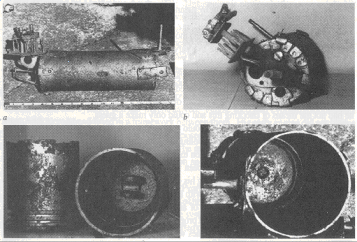 Subsequent
searches of the area then discovered some remains of his earlier aircraft which had been
thrown onto a rubbish dump in the mostly dried up river bed where he had last landed
almost fifty years before.
Subsequent
searches of the area then discovered some remains of his earlier aircraft which had been
thrown onto a rubbish dump in the mostly dried up river bed where he had last landed
almost fifty years before. 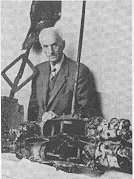 Here
is the late George Bolt with items recovered by him.
Here
is the late George Bolt with items recovered by him.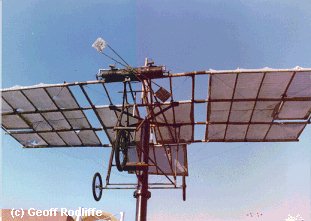 In
1974 the NZBC was involved in the making of a documentary film entitled "Richard
Pearse." Whilst this turned out to be rather less than the hoped for historic record,
it did serve to bring Pearse's achievements to the attention of the NZ populace at large.
In
1974 the NZBC was involved in the making of a documentary film entitled "Richard
Pearse." Whilst this turned out to be rather less than the hoped for historic record,
it did serve to bring Pearse's achievements to the attention of the NZ populace at large.